Close Gap Between Front Teeth: Bonding, Veneers, Invisalign
Dr. Nicole EliaOctober 29, 202610 min read
Key Takeaways
You can close a gap between front teeth with bonding, veneers or Invisalign, and the right choice depends on the cause, size and your goals.
Bonding and veneers cover the teeth to close the space, while Invisalign moves the teeth together.
Clear aligners can treat 90% of mild-to-moderate alignment issues, according to the American Journal of Orthodontics.
Veneers are not reversible because enamel is removed to place them, according to the ADA.
Some 42% of adults aged 30 and older have some form of periodontal disease, so a new gap deserves a gum check.
A Digital Smile Design preview shows your projected smile before treatment begins.
If you searched "close gap between front teeth," the short answer is that you have three good options: bonding, veneers or Invisalign. At Elia Family Dental in Wall Township, Dr. Nicole Elia offers all three through her cosmetic dentistry care, and the right one depends on the cause and size of your gap.
You notice it in every photo and every mirror: a small space between your two front teeth. Some people love theirs. Others spend years smiling with their lips closed. If you're in the second group, closing the gap is straightforward, once you know what's causing it.
This guide starts with the gap itself, then compares the three ways to close it by speed, cost and how long the result lasts. It's general education only, and an exam shows what fits your teeth.
Want to See Your Smile With the Gap Closed?
Book a consultation and Dr. Elia will check the cause of your gap and show you a preview of each option.
A gap between the front teeth can come from tooth size, jaw alignment, or changes in the gums and bone that support the teeth. The ADA notes that tooth and jaw alignment problems may be inherited or result from injury, early or late tooth loss, or thumbsucking.
Teeth that are small relative to the jaw
An inherited alignment pattern
Injury, or early or late tooth loss
Habits such as thumbsucking in childhood
Gum or bone changes that let teeth drift in adulthood
The last cause deserves attention. The National Institute of Dental and Craniofacial Research explains that in advanced gum disease the bone supporting the teeth is destroyed, which may cause looseness and shifting of teeth. The ADA also lists permanent teeth that are loose or separating as a warning sign, and notes that gum disease often causes no discomfort, so you may not know you have it.
Gum disease is common. Some 42% of adults aged 30 and older have some form of periodontal disease, according to CDC 2024 data. That's why a gap that appears or widens in adulthood should be checked before it's closed.
Closing a gap without finding the cause can backfire. If your gums are the issue, bonding or aligners won't hold for long. A dentist checks your gums and bite first, then recommends the right fix. Dr. Elia listens first, then explains what she sees.
Close Gap Between Front Teeth: What Are Your Options?
You can close a gap between front teeth with dental bonding, porcelain or composite veneers, or Invisalign clear aligners. Bonding and veneers cover the teeth to close the space, while Invisalign moves the teeth together.
A small space between the front teeth is one of the most common cosmetic concerns.
Option
How it closes the gap
Speed
Permanence
Bonding
Tooth-colored material is added to the sides of the teeth
Often the quickest
Can stain or wear, and is easy to repair, per the ADA
Veneers
Thin custom shells cover the front surface of the teeth
A few visits
Porcelain is strong and long-lasting, but not reversible, per the ADA
Invisalign
Clear aligners gradually move the teeth together
Average of 6-18 months, per the AAO
Natural enamel stays intact, and a retainer keeps the result
Notice the difference in approach. Two options cover the space, and one removes it by moving teeth. That distinction affects almost everything else, from timing to upkeep.
Elia Family Dental offers all three, so the recommendation isn't tilted toward one product. You get a plan built around your teeth, your goals and your budget.
Gap size changes the picture. A small space between two teeth is a different job from a wide gap or several gaps across the smile. Bonding and veneers work by adding width, so larger gaps can make teeth look too wide. Moving teeth, by contrast, redistributes the space, which can look more natural when the gap is big.
How Does Dental Bonding Close a Gap?
Dental bonding closes a gap by adding tooth-colored composite material to the sides of the teeth, then shaping and polishing it to blend in. It doesn't move the teeth. It makes them wider, so the space disappears.
Bonding uses tooth-colored composite that is shaped, matched and polished to blend in.
The ADA describes composite material in its guide to veneers: it may need less enamel removed and fewer visits, and it's easier to fix if damaged, but it isn't as stain- or wear-resistant as porcelain. That tradeoff applies to bonding, which uses a similar material.
Bonding is part of Elia's cosmetic dentistry, alongside veneers, whitening and smile makeovers. Our guide to veneers vs bonding goes deeper on the comparison.
Bonding tends to suit a small gap in otherwise healthy, well-aligned teeth, when you want a quick, less invasive change. It's also a sensible first step if you aren't ready to commit to something harder to reverse. Elia's cosmetic process pays close attention to shade, symmetry and a natural-looking result.
How Do Veneers Close a Gap?
Veneers close a gap by covering the front surface of the teeth with custom shells, shaped so the space disappears. According to the ADA's MouthHealthy guide to veneers, they can mask gaps in your smile.
The ADA describes two main types. Porcelain veneers are strong, long-lasting and natural-looking, though they tend to cost more. Composite veneers may need less enamel removal and fewer visits, but they aren't as stain- or wear-resistant.
Treatment is not reversible, because enamel is removed to place a veneer, according to the ADA. Porcelain veneers can last 10-15 years with proper care, according to the Journal of Prosthetic Dentistry, though they can chip, crack or loosen over time.
Veneers may not be a good choice if you clench or grind your teeth or have a deep overbite, according to the ADA. Any decay or gum disease needs treatment first, because placing veneers over unhealthy teeth may worsen existing problems.
Digital Smile Design pairs well with veneers. Elia's page on it describes the technology as great for veneers, makeovers and crowns, because you see the closed gap on screen before anything is placed.
How Does Invisalign Close a Gap?
Invisalign closes a gap by gradually moving the teeth together with a series of custom clear aligners. Elia Family Dental's Invisalign treats crowding, spacing and many common bite problems, and the iTero scanner shows a projected preview of your result before you start.
Clear aligners can treat 90% of mild-to-moderate alignment issues, according to the American Journal of Orthodontics. The American Association of Orthodontists reports an average of 6-18 months for clear aligner treatment. At Elia Family Dental you wear each set for about two weeks, then move to the next.
The retainer is not optional. The ADA notes that retainers preserve and stabilize the results of orthodontic treatment, and teeth can drift without one. Your treatment ends with a custom retainer to keep the gap closed.
Invisalign keeps your natural enamel intact, and the aligners come out for eating, brushing and flossing. If you're an adult wondering whether it's too late, our guide to Invisalign for adults answers that directly.
If the gap comes with crowding elsewhere, aligners treat the whole bite, not just the space. That's a real advantage when the gap is one symptom of a bigger alignment pattern.
Which Option Is Fastest, Cheapest and Longest-Lasting?
Bonding is usually the fastest and least invasive, porcelain veneers tend to be the most durable but cost more, and Invisalign preserves natural enamel but takes months. The right pick depends on the size of your gap and what you value most.
Fastest: bonding, often in a single visit
Most durable: porcelain veneers, with proper care
Most tooth-preserving: Invisalign, since enamel isn't removed
Easiest to repair: bonding, since composite is easier to fix
We don't list dollar amounts here, because cost depends on your teeth, the number of teeth involved and your plan. The ADA notes porcelain veneers tend to cost more than composite, so ask for each plan in writing and compare the total, not just the first number.
The ADA also notes that veneers are considered cosmetic dentistry, so insurance may not cover them unless they're deemed medically necessary. Invisalign coverage varies by plan. Elia Family Dental accepts Delta Dental, Blue Cross Blue Shield, Cigna, Principal and most PPO plans, and verifies your coverage before treatment begins.
Sunbit and CareCredit financing are available, and Sunbit doesn't require a hard credit check. We don't accept HMO, Medicaid or Medicare plans, so call us if you're unsure which category your plan falls into.
Which Option Fits Your Type of Gap?
A small gap in otherwise healthy, well-aligned teeth often suits bonding or veneers, while larger gaps, several gaps, or gaps with crowding often suit Invisalign first. Gum or bone problems come first, whatever you choose.
A small gap in healthy teeth: bonding is often considered first
A gap plus a shape or color concern: veneers, planned with a digital preview
A larger gap, several gaps, or crowding: Invisalign, to move the teeth into place
A gap that appeared recently, or teeth that feel loose: a gum check before any treatment
Some patients combine approaches. For example, they close most of the space with Invisalign, then refine a tooth's shape with bonding or a veneer. Elia's cosmetic process builds a personalized combination of treatments with clear costs, timelines and expected results.
If you're deciding between two options, ask a simple question: what matters more, speed or preserving your natural teeth? Speed points toward bonding or veneers. Preservation points toward Invisalign. Your answer helps Dr. Elia narrow the plan.
Not sure which category you're in? That's what the exam is for. A short look at your gums, your bite and the spacing tells you more than any online quiz can.
How Does a Smile Preview Help You Choose?
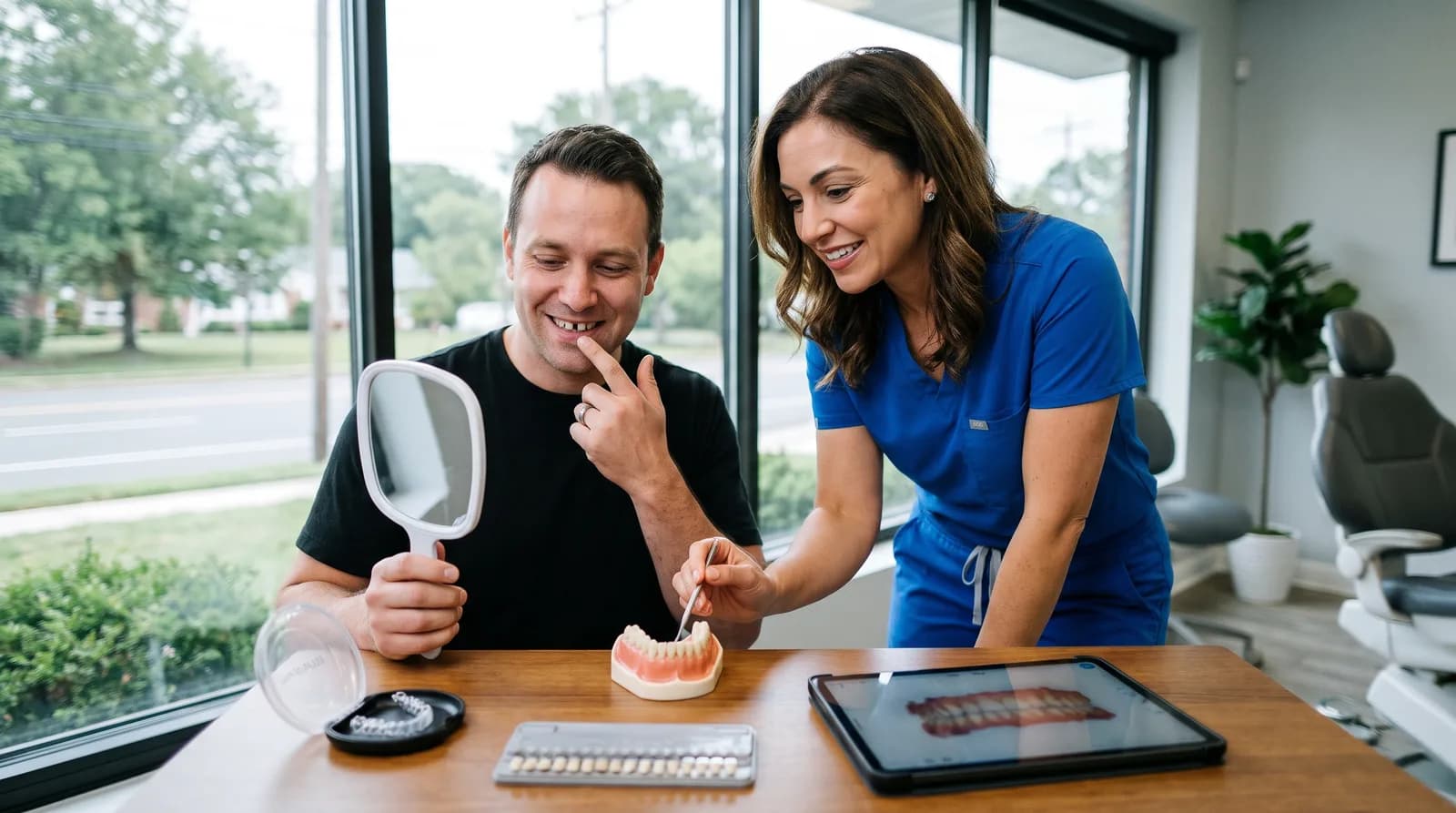
A smile preview lets you see how each option would look before any treatment begins. Elia Family Dental uses Digital Smile Design for cosmetic plans and the iTero scanner for Invisalign, so you compare closed-gap results on screen first.
A preview shows how each option would look before any treatment begins.
You see your projected smile on screen before treatment
You give feedback, and Dr. Elia reworks the design until it's right
A physical model lets you see and feel the changes in 3D
Nothing changes until you've said yes to the result
According to the American Academy of Cosmetic Dentistry, 99.7% of Americans believe a smile is an important social asset. Our guide to what a digital smile design mockup actually shows you explains what to look for in a preview.
A preview also answers the question many people can't: will the gap look natural once it's closed? Seeing the result takes the guesswork out of it.
You help shape the design, too. Bring a photo of a smile you like, and say what feels like too much or too little. The design adjusts until it looks right to you, and nothing is placed until you approve it.
What Should You Expect at a Gap-Closing Consultation?
Expect a relaxed, judgment-free conversation where Dr. Elia listens first, checks the cause of your gap, shows you a digital preview and builds a plan with clear costs and timelines. Your insurance is verified before treatment begins, so there are no surprises about what your plan covers.
Smile consultation. We talk through your goals and concerns in a relaxed setting.
Digital preview. You see projected results on screen and adjust until it looks right.
Custom treatment plan. A personalized combination of treatments with clear costs, timelines and expected results.
Precise treatment. Careful work with close attention to shade, symmetry and a natural-looking result.
Still torn between aligners and veneers? Our comparison of Invisalign vs veneers weighs the two side by side.
The best way to close a gap isn't a single treatment. It's the one that fits your gap, your gums and your goals. Book a visit, and Dr. Elia will show you what each path looks like before you decide.
Results may vary. Please consult with your dentist at Elia Family Dental for personalized treatment recommendations.
Ready to Close the Gap?
Book an appointment with Elia Family Dental and Dr. Elia will preview your options on screen.
Dry socket symptoms after tooth extraction: what they feel like, how to prevent them, and when to call. Same-day emergency extractions in Wall Township.
Invisalign vs veneers: compare straightening and reshaping for a crooked smile by time, tooth preservation and results. See how Dr. Elia helps you choose.
Oct 29, 202611 min read
Ready When You Are
Book your visit with Dr. Elia online or call us, and we'll take it from there.