Orthodontics
Invisalign Not Fitting? What to Do When Aligners Won't Seat
Invisalign not fitting? Learn what's normal with a new set, how chewies help and when to call Elia Family Dental in Wall Township, NJ.
Nov 8, 202612 min read



Invisalign lisp is one of the most common worries people have before starting clear aligners, and it's a fair one: aligners sit between your tongue and your teeth, so some speech change is common. Elia Family Dental's Invisalign treatment is planned with an iTero 3D scanner and includes video consultations for convenient check-ins, so you can ask questions as you go.
The honest answer to "how long will it last" is that it varies, and nobody can promise you a timeline. Studies suggest most people adapt within a couple of weeks, some take a month or two, and in one study of adults, speech hadn't fully returned to normal after two months. This guide walks through what the research found, what you can do to help yourself adjust and when it's worth calling your dentist.
It's general education only, and your dentist can tell you what to expect for your own mouth.
Worried About Speech Before You Start Invisalign?
Book a free consultation and Dr. Elia will look at your smile, talk through your goals and answer your questions about what to expect.
Book Appointment →An Invisalign lisp is a change in how certain sounds come out, most noticeably /s/ and /z/, because the aligners sit between your tongue and your teeth. A 2023 systematic review of clear aligners and speech found that aligners can influence the clarity and delivery of speech, affecting sounds such as /s/, /z/, /sh/, /th/ and /ch/.
The reason is simple. Your tongue is used to touching your teeth and the roof of your mouth in a particular way when you make those sounds. A thin layer of plastic over your teeth changes the space your tongue works in, and it takes practice for your tongue to adjust. A summary of the same research in Evidence-Based Dentistry notes that some patients reported impairment in the lingual space, which is the room your tongue normally has.
The sounds most affected are the sharp, hissing ones, which depend on a precise gap between the tongue and the front teeth. That's why people usually describe an Invisalign lisp as a soft or slushy "s", not as a problem with every word. Other sounds can be affected too, which is why some people also notice a slightly different feel when they say "sh" or "th".
Importantly, aligners aren't unusual in this respect. All seven studies in the review reported that aligners could influence speech similar to fixed appliances, so speech change is a recognized effect of many orthodontic treatments. If you're comparing options, our guide to Invisalign vs braces for adults covers how the two differ in everyday life.
A lisp or other speech change is common with clear aligners. The 2023 systematic review, which assessed seven studies covering 332 patients, concluded that the likelihood of speech difficulties appears high, and all seven studies reported that aligners could influence the clarity and delivery of speech.

It's worth reading that finding with the right amount of caution. The review's authors downgraded the level of evidence to low because of weaknesses in how the studies were designed. Two studies had a moderate risk of bias and five had a serious risk of bias, and a meta-analysis wasn't possible because the studies were too different from each other. They also called for more well-designed randomized trials, especially on long-term effects.
What that means for you is practical, not alarming. It's reasonable to expect that you may notice some change in your speech, and it's reasonable to plan for it. If you work in a role where you speak a lot, our guide to Invisalign for young professionals explains how people fit treatment around busy schedules, and it can help to start when you have a few quieter days to practice.
The review also notes that orthodontists should counsel patients about the potential for temporary speech difficulties before treatment, which is exactly the conversation Dr. Elia has at a consultation. Knowing what's normal in advance makes the first days much less worrying.
It varies, and nobody can promise a timeline. In the 2023 systematic review, the speech difficulties were temporary and most patients recovered in 7 to 14 days, while a few took 30 to 60 days. Another study of adults found that speech had not fully returned to normal after 2 months.
| Study | Who was studied | What it found |
|---|---|---|
| 2023 systematic review, European Journal of Orthodontics | 7 studies, 332 patients | Most patients recovered in 7 to 14 days; a few took 30 to 60 days |
| 2022 study, The Angle Orthodontist | 24 adults with Invisalign and 20 adults with fixed braces, assessed before, right after and 2 months after starting | Invisalign significantly affected speech; patients adapted somewhat, but speech had not returned to normal at 2 months |
| Evidence-Based Dentistry summary, 2024 | Seven aligner studies | Time to recovery varied greatly, from about a week to two months in some cases |
The adult study is the one to keep in mind if you're an adult starting treatment. Speech was assessed three ways: by acoustic analysis, by six speech and language pathologists and by a patient questionnaire. The authors noted that adults generally have reduced speech adaptation abilities compared with children. Their conclusion was that Invisalign significantly affected speech and that, although patients adapted to some degree, speech didn't return to normal after two months.
These findings don't contradict each other. They measured different things in different groups at different times, and some used instruments that pick up small differences a listener might not notice. The takeaway is that a typical adjustment is measured in days to weeks, some people take longer, and subtle differences may linger for some. That's why the honest answer is a range, not a promise.
If you're wondering whether your Invisalign lisp is following a normal timeline, the best test is direction, not speed. Is it a little clearer each week? Do people understand you easily? If the answer is yes, you're probably adapting. If it feels stuck, or if it's affecting your work or your confidence, that's a good reason to check in with your dentist.
Wearing your aligners as directed and practicing speaking with them in gives your tongue the most chance to adapt. The ADA gives similar practical advice for removable partial dentures: if certain words are hard to pronounce, practice reading out loud and repeat the words that give you trouble, and with time you'll become accustomed to speaking with the appliance.

An honest note on these tips: the studies above measured how speech changes, not which exercises work best, so treat them as practical suggestions rather than proven fixes. They cost nothing, they're easy to try and they match the way people learn to speak with any new appliance, which is by using it.
It can be tempting to take the aligners out whenever your speech feels awkward, but that gives your tongue less time to adjust to them. Follow the wear instructions Dr. Elia gives you, and use meetings or calls you can't avoid as a reason to practice beforehand, rather than a reason to remove the aligners.
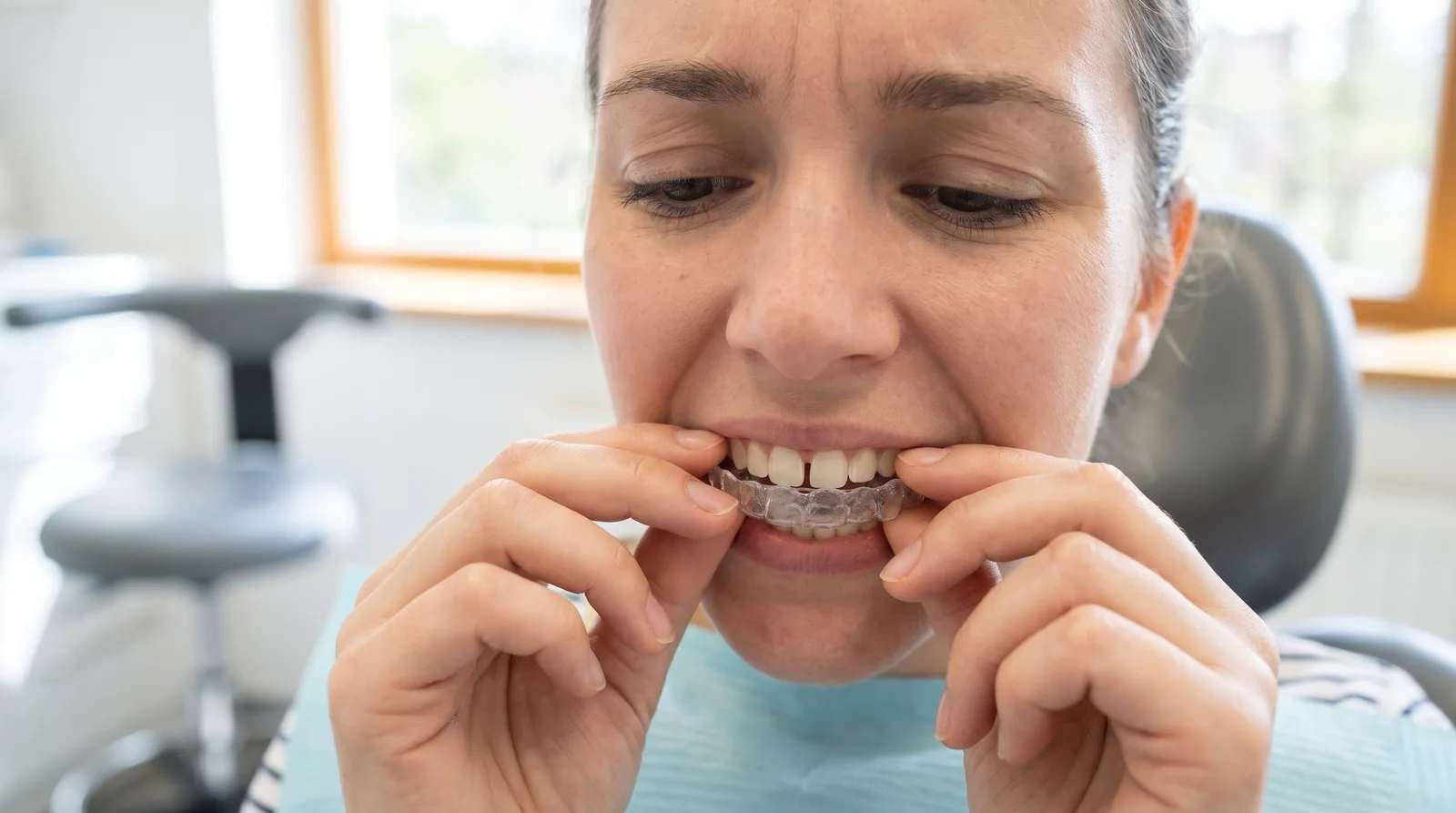
An aligner that isn't fully seated may feel bulkier and can make speech feel less clear, so check the fit if your lisp seems stuck. Healthline says an aligner needs to fit snugly each time you put it in, and describes a visible air gap as the sign it isn't fitting well.
Look in a mirror after you put the aligner in. If you see a gap along the edge of a tooth, the aligner may not be sitting where it should. If you have attachments, which are the small tooth-colored bumps described in our guide to Invisalign attachments, the aligner should sit over each one. A new set can feel snug for a few days, and that's normal, but a visible gap is worth a call. Our guide to Invisalign not fitting covers chewies and when to contact the office.
Fit and speech are connected in a simple way: an aligner that sits closely to the teeth leaves your tongue more room than one that's perched loosely. That's one reason a stubborn lisp, or one that returns, deserves a fit check rather than just more patience. A quick look from the team can tell you whether it's a normal adjustment or something to correct.
Don't try to fix a fit problem by forcing the aligner or by skipping ahead to the next set. Ask first. Elia Family Dental offers video consultations, so you can show the team how the aligner looks in your mouth and get an answer without scheduling a full visit.
Talk to your dentist if your speech isn't improving as you expected, if it's affecting work or daily life, or if the aligner doesn't seem to fit. Elia Family Dental offers video consultations for convenient check-ins, so you can ask without making a trip to the office.
When you reach out about an Invisalign lisp, say which sounds feel different and when it started, and have your set number ready if you know it. Photos help for fit questions. Dr. Elia can look at the fit, explain what's normal for your stage of treatment and tell you whether to keep going or come in.
There's no set deadline after which you should worry, because people adapt at different speeds. The point of calling is reassurance and a plan, not a verdict. Most speech questions are answered quickly, and most people find that a short conversation takes a weight off. If you're not yet a patient, you can raise the same questions at a consultation and hear how Dr. Elia would approach your case.
For most people, no, but it's a fair thing to weigh. Speech change is a recognized effect of orthodontic appliances, fixed ones included, and in a cross-sectional survey of 200 patients, satisfaction rates were 92% for clear aligners and 76% for traditional braces.
Satisfaction covers many things, not only speech, so that figure shouldn't be read as proof about an Invisalign lisp. It does show that many patients find the overall experience manageable. Invisalign's other strengths matter to people too: Elia's aligners are removable for eating, drinking, brushing and flossing, with no food restrictions, and most people won't notice you're wearing them.
If you speak for a living, or you're an adult worried about how treatment will fit your life, our guides to Invisalign for adults and clear aligners for teens vs adults cover what different patients experience. For perspective on how long treatment can take, the ADA's page on braces notes that most people are in orthodontic treatment for one to three years, followed by a retainer, and our guide to Invisalign retainers explains what comes after.
The sensible way to decide is to weigh the temporary adjustment against what you want from the result. A short period of speaking more carefully is a small price for many people, and a long-term concern for a few. A consultation lets you talk through your own situation honestly, with no pressure to start.
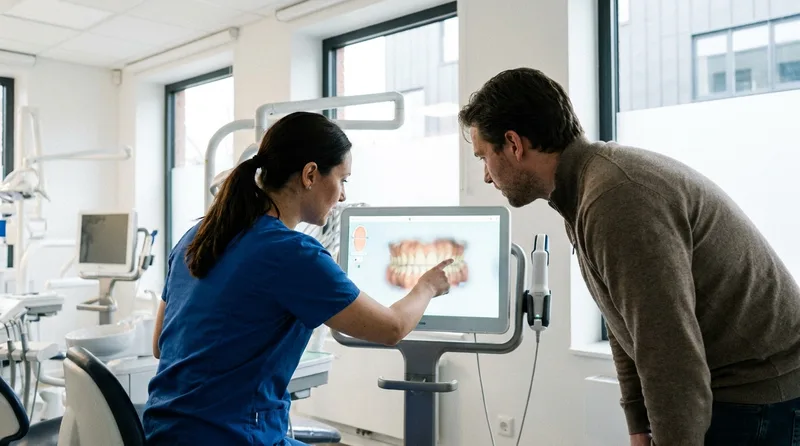
The first step is a free consultation, where Dr. Elia looks at your smile, talks through your goals and confirms whether Invisalign is the right fit, including answering your questions about speech. The iTero 3D scanner can show you a preview of your projected smile before you start.
Bring your questions about Invisalign lisp and speech, especially if you speak a lot at work or you've had speech concerns before. Dr. Elia can explain what the studies found, what's normal and when to check in, so you know the plan before your first set. If something feels off later, video consultations are available for convenient check-ins.
Elia Family Dental accepts Delta Dental, Blue Cross Blue Shield, Cigna, Principal and most PPO plans and verifies your coverage before treatment begins. Sunbit and CareCredit offer flexible monthly payment plans, and Sunbit doesn't require a hard credit check. You can start with a conversation, and there's no obligation to proceed.
Results may vary. Please consult with your dentist at Elia Family Dental for personalized treatment recommendations.
Ready to Ask Your Questions About Invisalign?
Book a free consultation with Elia Family Dental and Dr. Elia will walk you through what to expect, including your speech questions.
Book an Appointment →Prefer to talk it through first?
Call 732-681-8604 →Written By
Lead Dentist
Invisalign not fitting? Learn what's normal with a new set, how chewies help and when to call Elia Family Dental in Wall Township, NJ.
Does teeth whitening work on crowns? Learn why crowns, veneers and fillings keep their shade and how to plan around them in Wall Township, NJ.
Bridge vs partial denture: compare how each replaces missing teeth, how they feel day to day and how to choose, with Elia Family Dental in Wall Township.
Book your visit with Dr. Elia online or call us, and we'll take it from there.