How Much Do Dentures Cost? What Changes the Final Price
Dr. Nicole EliaNovember 11, 202612 min read
Key Takeaways
How much dentures cost depends on the type, how many teeth you're replacing and what your mouth needs first, so a written estimate after an exam is the reliable answer.
Conventional dentures are ready about eight to 12 weeks after teeth are removed, while immediate dentures need more adjustments during healing, per WebMD.
The price covers a series of steps: impressions, models, try-in visits, the final denture and adjustments, not just the teeth.
Dentures rest on gums and jawbone that shrink over time, so relining, rebasing or replacement is part of the long-term cost.
WebMD says most dental insurance providers cover some or all of the cost of dentures, so verify the specifics with your plan.
Elia Family Dental explains options, timelines and costs before treatment, verifies insurance and offers Sunbit and CareCredit monthly payment plans.
How much do dentures cost? The honest answer is that it depends on the type of denture, how many teeth you're replacing and what your mouth needs first. We don't list dollar amounts here, because a fair estimate comes from an exam, not a number quoted over the phone. What we can do is explain what changes the final price, including the parts people often overlook, like adjustments and relining over time. Elia Family Dental's restorative dentistry team walks you through your options, timelines and costs before anything begins.
This guide covers why one price can't fit everyone, the types of dentures and how they differ, what's included in the cost, how extractions and healing affect it, why the cost continues over time, how insurance works, how to afford dentures without insurance and what to ask for. It's general education only, and your dentist can tell you what your mouth needs after an exam.
Considering Dentures and Want Clear Costs?
Book a consultation and our team will examine your mouth, explain your options and walk you through your costs and coverage before treatment begins.
How Much Do Dentures Cost, and Why Can't One Price Fit Everyone?
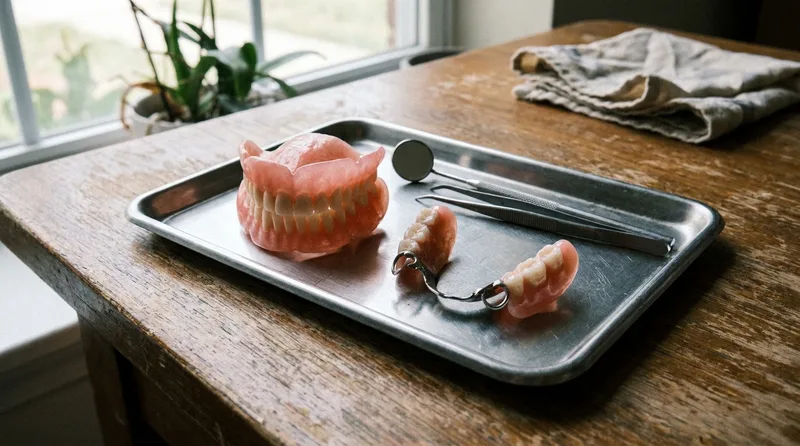
How much dentures cost depends on the type you need, how many teeth you're replacing and what your mouth needs first. WebMD describes two types, complete and partial dentures: complete dentures are used when all teeth are missing, and partial dentures when some natural teeth remain.
Tooth loss is common, but complete tooth loss is less common than it once was. An estimated 120 million Americans are missing at least one tooth, according to the American College of Prosthodontists. A study of national surveys found that complete tooth loss among US adults fell from 18.9% in 1957 to 1958 to 4.9% in 2009 to 2012, though about 12.2 million people were still affected in 2010. Gum disease is one reason: an estimated 42% of dentate US adults aged 30 or older have periodontitis, according to an analysis of national survey data from 2009 to 2014 by CDC researchers.
That range of situations is why prices vary so much. Someone replacing a few teeth with a partial denture needs very different work from someone replacing a full arch, and someone who still needs teeth removed has more steps than someone whose gums have already healed. A single number can't capture all of that.
At Elia Family Dental, costs are explained after an exam, so the numbers reflect your own mouth. The team reviews your options, your timeline and your insurance, and you leave with a plan you understand. If cost is a worry, say so early, because the plan can often be sequenced and paid for in a way that fits your situation.
What Types of Dentures Are There, and How Do They Differ in Price?
There are three main kinds: conventional full dentures, immediate full dentures and partial dentures. WebMD says a conventional denture is ready for placement about eight to 12 weeks after teeth are removed, an immediate denture is made in advance and placed as soon as teeth are removed, and a partial denture is used when one or more natural teeth remain.
Full dentures replace all teeth, while partial dentures replace some when natural teeth remain.
Type
What it is
What can affect the cost
Conventional full denture
Made after teeth are removed and the gums have begun to heal, ready about 8 to 12 weeks later, per WebMD
A planned healing period and a full set of appointments
Immediate full denture
Made in advance and placed as soon as teeth are removed, so you are never without teeth
WebMD says it needs more adjustments during healing and is generally a temporary solution until a conventional denture can be made
Partial denture
Replacement teeth on a pink or gum-colored base, sometimes joined by a metal framework, for when natural teeth remain
The number of teeth replaced and whether a framework or crowns on natural teeth are needed
Precision partial denture
A removable partial with internal attachments instead of clasps, per WebMD
Extra work on the natural teeth that hold the attachments
Partial dentures are often compared with bridges, since both replace some teeth. Our guide to bridge vs partial denture explains how the two differ. WebMD notes that a partial denture also prevents the natural teeth from shifting position, which is worth considering when weighing the options.
Appearance and fit matter to the result too. WebMD says dentures are made to closely resemble your natural teeth, so there should be only a small noticeable change in appearance, and they may even improve your smile and fill out your facial appearance. How natural the result looks depends on careful fitting over several appointments, which is part of what the price reflects.
What Is Included in the Cost of Dentures?
The cost of dentures covers more than the teeth themselves. WebMD says the denture process takes a few weeks and several appointments, and it includes impressions and measurements, models, try-in visits, the final denture and adjustments, so the price reflects a series of steps, not a single product.
Exam and planning. Your dentist or prosthodontist decides which type of denture suits you.
Impressions and measurements. A series of impressions of your jaw and measurements of how your jaws relate to one another.
Models and wax forms. These are made in the exact shape and position of the denture to be made.
Try-in visits. You try the model several times, and the denture is assessed for color, shape and fit before the final denture is made.
The final denture. The finished denture is made from the approved design.
Adjustments. These are made as necessary after you start wearing it.
Try-in visits let you and your dentist check color, shape and fit before the final denture is made.
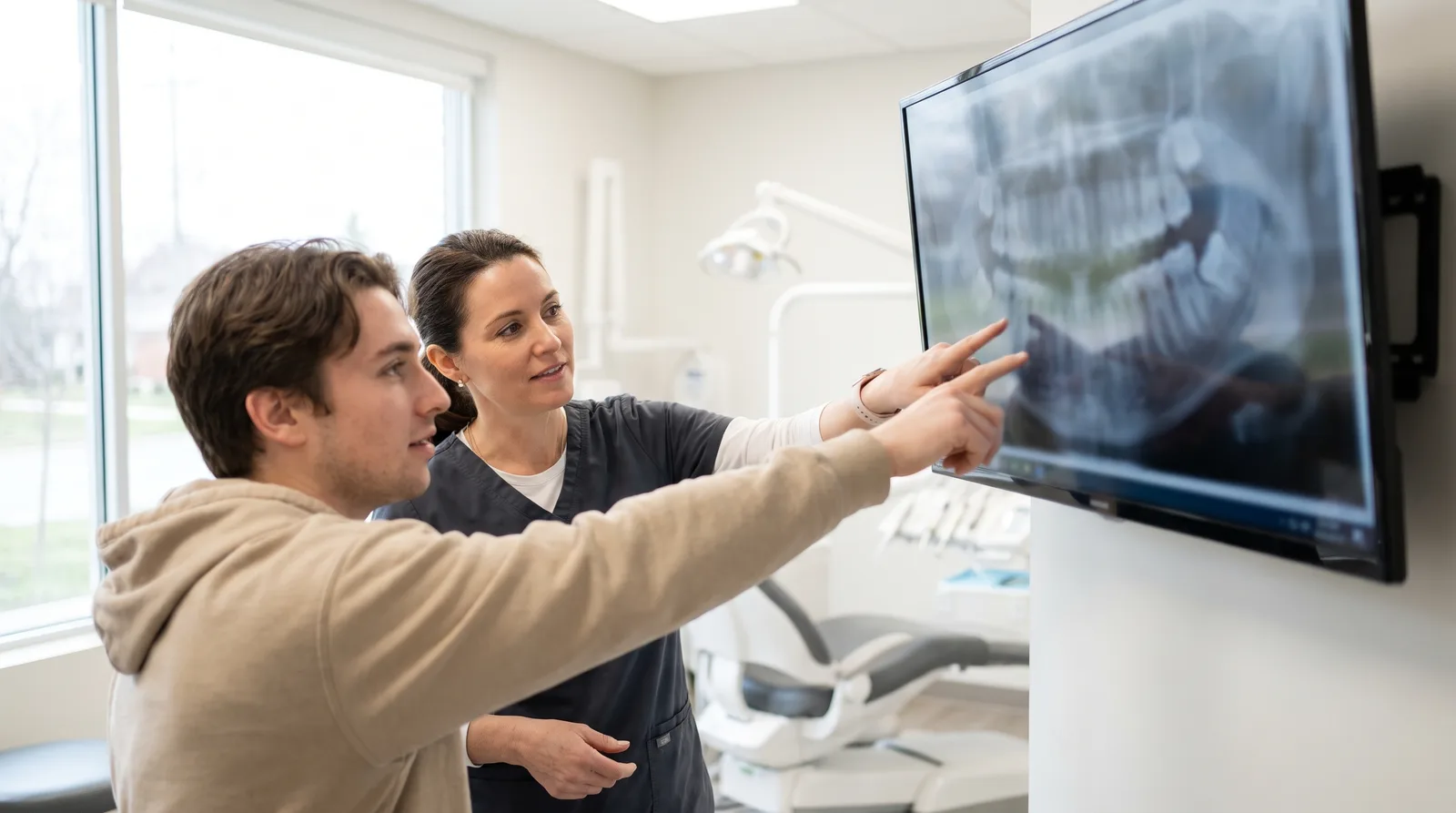
The first step deserves a closer look. At Elia, digital X-rays and 3D imaging assess the situation precisely, and your gum and bone health are checked before anything is planned, because the health of your gums and the shape of your jaw affect how well a denture fits. If gum disease is present, it may need treatment before dentures are made, which is one more reason an exam comes before an estimate.
When you ask how much do dentures cost, ask what each estimate includes, because each step takes appointment time and skill. A clear estimate lists the exam, the imaging, each stage of the fitting and the follow-up adjustments, so you can compare it fairly with another quote. If a price seems unusually low, ask what's missing from it, because adjustments and follow-up visits are the parts most often left out.
How Do Extractions and Healing Affect the Price?
If teeth need to be removed first, extraction is part of the total, and the healing period shapes the plan. WebMD explains that bones and gums shrink over time, especially during the healing period after teeth are removed, which is why immediate dentures need more adjustments and conventional dentures wait for the tissues to heal.
That's a real trade-off. An immediate denture means you aren't without teeth during healing, which is a significant benefit for many people. The cost is the extra adjustments, and WebMD says an immediate denture should generally be considered a temporary solution until a conventional one can be made, which can mean a second denture and another set of appointments. A conventional denture avoids that but means waiting. Our guides to simple vs surgical extraction and the tooth extraction recovery timeline explain what removal and healing involve.
Colgate adds that immediate dentures typically need to be relined several months after being placed, because the bone supporting the teeth reshapes as it heals, which makes the denture loose. Knowing this in advance helps you ask the right question: is relining included, and when would it happen? That single answer can change how you compare two estimates.
Your dentist can tell you which approach suits your teeth and your timing. If you're replacing a full arch, our guide to full mouth restoration cost explains how larger plans are priced and phased, which can help you see where dentures fit among your options.
Why Do Dentures Cost More Over Time Than the First Estimate?
Dentures need ongoing care, so the first estimate isn't the whole cost. WebMD says dentures rest on gum tissue and jawbone, which shrink over time, so a loose fit may mean a need for a denture adjustment or new dentures, and Colgate says a denture will need to be relined, remade or rebased over time due to normal wear.
Relining: adding material to the inside of the denture so it fits your changed gums.
Rebasing: making a new base while keeping the existing denture teeth, as Colgate describes.
Remaking: a new denture when the old one is worn or the fit has changed too much.
Adjustments: small changes to relieve sore spots or improve the bite.
Check-ups: regular visits so your dentist can check the fit and your gums.
Care products: a cleanser and a soft brush for daily care.
That's why comparing options by the first estimate alone can mislead. WebMD notes that dental implants can support dentures to offer more stability, and that implant-supported options usually cost more but more closely resemble real teeth. A systematic review of studies with at least 10 years of follow-up found a cumulative dental implant survival rate of 94.6%, according to the International Journal of Oral and Maxillofacial Surgery. Our guides to dentures vs dental implants, implant-supported overdentures and dental implant cost compare them in detail, and adjusting to new dentures explains what the first month feels like.
Does Dental Insurance Cover Dentures?
Often, at least in part, but it depends on your plan. WebMD says most dental insurance providers cover some or all of the cost of dentures, and that you should contact your company for specifics. Elia Family Dental accepts Delta Dental, Blue Cross Blue Shield, Cigna, Principal and most PPO plans.
The team verifies your coverage before treatment begins. What you pay usually depends on your deductible, your coinsurance share, your annual maximum and whether the office is in your network. Our guides to dental insurance explained and dentists that accept your insurance cover how those pieces work. If your plan isn't on the list, Elia will still work with it, and out-of-network patients are welcome.
Are dentures covered, and at what level? Ask whether full and partial dentures are treated differently.
How often are they covered? Some plans limit how often a denture can be replaced.
Are extractions covered separately? Teeth removed before dentures may be handled under a different category.
Are relines and adjustments covered? These can add up over time.
How much of my annual maximum is left? A yearly limit can matter for larger plans.
Insurance details change from plan to plan and year to year, so it's worth confirming your benefits close to your appointment. Call 732-681-8604 and the team will verify your coverage, so you know your portion before treatment begins.
How Can You Afford Dentures Without Insurance?
Without insurance, flexible payment plans are the main option. Elia Family Dental works with Sunbit and CareCredit, which offer monthly payment plans, and Sunbit doesn't require a hard credit check. Our guides to dental care without insurance, CareCredit vs Sunbit and dental financing with Sunbit explain how each works.
Which type do you recommend, and why? Ask how it fits your teeth and your timing.
What does the estimate include? Ask about the exam, impressions, try-ins, the final denture and adjustments.
Are extractions included? Ask what happens first if teeth must be removed.
What about relining and follow-up? Ask when it would happen and whether it's included.
What will my insurance pay? Ask the office to verify your coverage first.
How can I pay my share? Ask about Sunbit, CareCredit and other options.
What are my alternatives? Ask about bridges and implant-supported options, and what they'd involve.
The most helpful step is to ask early, and to ask for the estimate in writing. A clear number, and a plan for how to pay it, takes much of the stress out of a major decision. It also lets you compare options on what they include over time, not just the first figure.
Think about the cost over several years, not just the first appointment. Ask how relines, adjustments and replacements are priced, and whether follow-up visits in the first months are included. A denture that's well fitted and well cared for tends to need fewer corrections, so a careful fit at the start is part of good value, and it's the best way to answer how much do dentures cost over time for your situation.
What Is the First Step at Elia Family Dental?
The first step is a consultation with an exam and digital imaging, so the team can see which teeth you have, the health of your gums and bone and what your options are. Elia's planning step gives you clear options, timelines and costs, so you know exactly what to expect before anything begins.
A consultation with imaging is the first step in planning your care and your costs.
Dr. Elia can walk you through your options for replacing missing teeth, including dentures, bridges and implant-supported choices, and has advanced training through the Pankey Institute. Bring your questions, your insurance details and a list of your medications, and tell the team what matters most to you, whether that's cost, comfort, appearance or how long the treatment takes. You can start with a conversation, and there's no obligation to proceed.
Ask the team which parts of your denture care happen in the office and which involve outside specialists or a dental lab, so you know who to call for adjustments and how follow-up is handled. A clear answer to that question is as useful as a clear price.
Dental crown cost depends on material, tooth condition, prep work and coverage. See what affects the price and how same-day crowns fit in Wall Township.
Dental cleaning cost without insurance depends on what your visit includes. See what a cleaning covers and why exams and X-rays differ, in Wall Township.
Wisdom tooth removal cost depends on impaction, imaging, anesthesia and insurance. See what affects the final price and your options in Wall Township, NJ.
Nov 11, 202612 min read
Ready When You Are
Book your visit with Dr. Elia online or call us, and we'll take it from there.