Restorative Dentistry
Full Mouth Restoration Cost: What Affects the Price
Full mouth restoration cost depends on your teeth, treatments and materials. See what drives the price and how to compare quotes in Wall Township, NJ.
Nov 5, 202610 min read



Simple vs surgical extraction comes down to access: a simple extraction removes a tooth that is visible above the gumline, while a surgical extraction is used when a tooth is impacted, broken at the gumline or hard to reach, and needs a small incision in the gum. At Elia Family Dental in Wall Township, Dr. Nicole Elia handles both through her oral surgery and extractions care, with 3D imaging to plan the safest approach.
Your dentist says the word "extraction," and the next thing you hear is "simple" or "surgical." One sounds routine and the other sounds like an operating room. It's natural to wonder what actually separates them, and whether "surgical" means something is wrong.
It doesn't. This guide explains how each type works, how your dentist decides, what recovery involves and what comes after. It's general education only, and your exam and X-rays decide what your tooth needs.
Told You Need a Tooth Removed?
Book a visit and Dr. Elia will examine the tooth, review your X-rays and explain exactly what to expect.
Book Appointment →The difference is how the tooth is reached. A simple extraction removes a tooth you can see above the gumline, usually by loosening it and lifting it out. A surgical extraction reaches a tooth that is impacted, broken at the gumline or otherwise hard to access, and involves a small incision in the gum. Both remove the same tooth.
The ADA's MouthHealthy guide to extractions explains that an extraction means having a tooth removed, usually because of disease, trauma or crowding, and that your dentist will first numb the area to lessen any discomfort. That applies to both types.
"Surgical" describes the technique, not the seriousness. It means the dentist needs to open the gum, and sometimes remove a little bone or divide the tooth into sections, to take it out safely. Many people who need a surgical extraction have a perfectly ordinary reason, such as a wisdom tooth that never came in properly.
At Elia Family Dental, both are available. Elia's oral surgery page lists simple and surgical extractions, wisdom tooth evaluation and removal, and same-day emergency extractions, all with the goal of removing the tooth gently while preserving the surrounding bone and tissue wherever possible.
In a simple extraction, the area is numbed, the tooth is loosened and the dentist removes it. Because the tooth is visible and accessible, there's usually no incision and often no stitches. At Elia Family Dental, the visit follows four clear steps: evaluation, comfortable numbing, careful extraction and aftercare.

Most people are surprised by how little they feel. You may notice pressure, because numbing blocks sharp sensation rather than every sensation, but you shouldn't feel sharp discomfort. If you do, say so and the team will adjust. After the tooth is out, gauze is placed and the team explains how to care for the site. Most of recovery is simple: protect the clot and keep the area clean.
Fear is the real hurdle for many people. Dental anxiety is common. Our guide to judgment-free dental care explains how the team works with nervous patients.
In a surgical extraction, the area is numbed, a small incision is made in the gum to reach the tooth, and the dentist may remove a little bone or divide the tooth into pieces before taking it out. The gum is then usually closed with stitches.
The steps are the same four as a simple extraction, with more work in the third: evaluation, comfortable numbing, extraction and aftercare.
Why divide a tooth? Removing it in pieces is often gentler than forcing a whole tooth through a narrow path, especially when the roots are curved or the tooth is lodged against bone. It protects the surrounding bone, which matters if you plan to replace the tooth later.
3D imaging earns its place here. A flat X-ray shows a tooth in two dimensions, while a 3D scan shows where the roots run, how close nearby structures are, and how much bone surrounds the tooth. Elia uses digital X-rays and 3D imaging to plan the safest approach before anything begins.
Wisdom teeth are the most common reason for a surgical approach. Our guide to wisdom teeth removal explains when removal is actually necessary, and our guide to signs you shouldn't wait on a tooth extraction covers when to act promptly.
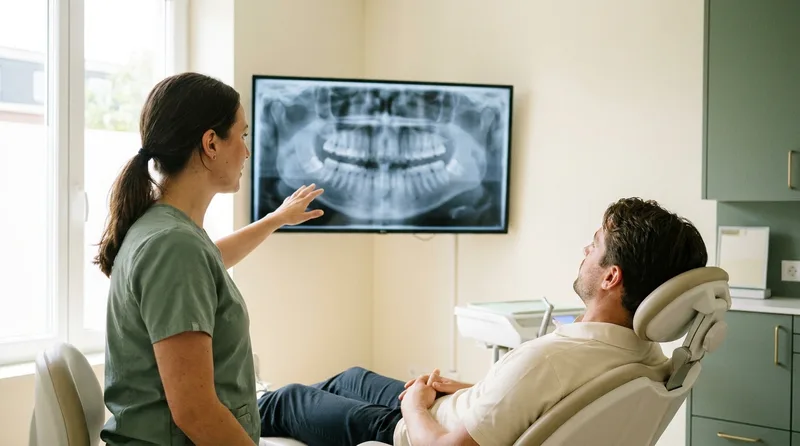
Your dentist examines the tooth and takes an X-ray, then decides based on how accessible the tooth is. The ADA's guide to wisdom teeth says that before making any decision, your dentist will examine your mouth and take an X-ray, and that together you and your dentist can discuss the best course of treatment.
Sometimes the plan changes. A tooth that looks simple can break during removal, which may call for a surgical approach. A good dentist explains that possibility beforehand, so it isn't a surprise if it happens. In most cases, the exam and X-ray show which type you need before the day of treatment.
If you're not yet sure the tooth has to come out, our comparison of root canal vs extraction weighs both paths. Keeping a tooth is usually worth considering when it can be saved.
Teeth that are impacted, broken at the gumline, or hard to reach usually need a surgical extraction. The ADA says impacted wisdom teeth are trapped in your jaw or under your gums, and lists reasons to remove them, including infection, cysts, damage to neighboring teeth, gum disease and decay.
| Situation | Usually | Why |
|---|---|---|
| A fully visible tooth with a healthy shape | Simple | The tooth can be reached and lifted out directly |
| A wisdom tooth trapped in the jaw or under the gum | Surgical | The ADA describes these as impacted; the gum has to be opened to reach them |
| A tooth broken off at the gumline | Surgical | Little or nothing is visible to grip |
| A tooth with curved or fused roots | Often surgical | The roots may need to be freed or the tooth sectioned |
| A loose tooth with advanced gum disease | Often simple | Bone loss may have already loosened it |
These are tendencies, not rules. Your X-ray decides, and the row that sounds like you may not be the one that applies. Your dentist can tell you which type you need, and why, at your exam.
Gum disease deserves a note. When it has loosened a tooth by destroying the bone around it, removal can be straightforward, but it also means the surrounding bone needs attention before an implant. Elia's periodontist can plan both together, so you don't have to coordinate two offices.
Recovery from a simple extraction is usually quicker, while a surgical extraction often brings more swelling and takes longer to settle. In both cases, protecting the blood clot is the key job, because the ADA says your mouth fills in the bone where the root was through a blood clot.

Those tips come from the ADA, and they apply to either type. The main complication to know about is dry socket. The ADA says it happens when the blood clot over the socket is displaced, leaving bone and nerves exposed, and that you should notify your dentist if it happens. Our guides to dry socket symptoms and the tooth extraction recovery timeline cover the details.
Ask your dentist about medicine for discomfort rather than guessing, since the right choice depends on your health and other medicines. And keep your follow-up visit. Elia checks in after extractions to make sure you're healing well.
Plan the replacement before the extraction, not after. Elia's oral surgery page promises a clear plan for replacing the tooth, and it preserves bone and tissue wherever possible, because the bone that held the tooth begins to change once the tooth is gone. The right plan depends on which tooth it is and what you want next.
Ask about all three at your consultation, even if you're not ready to decide. Whether the bone is protected at the time of extraction can change the options later, and it's much easier to plan before the tooth is out than after.
If the tooth is a front tooth, appearance becomes a planning concern from day one. A temporary replacement and a careful plan keep you comfortable in the meantime, and the sooner you ask, the more choices you'll have.
Cost depends on the type of extraction and how complex the tooth is, so the clearest answer is a personalized estimate after your exam. Elia Family Dental accepts Delta Dental, Blue Cross Blue Shield, Cigna, Principal and most PPO plans, and verifies your coverage before treatment begins. We'll still work with your plan if you're out of network.
We don't list dollar amounts here. Sunbit and CareCredit financing are available, and Sunbit doesn't require a hard credit check. We don't accept HMO, Medicaid or Medicare plans, so call us if you're unsure which category your plan falls into. If the tooth is causing urgent trouble, same-day emergency extractions are available during business hours, and our guide to emergency dental care in Wall Township explains what to do.
About 100 million Americans fail to see a dentist each year, according to the ADA, even though regular exams and good oral hygiene can prevent most dental disease. Catching problems early is the best way to keep a tooth in the first place.
If you're facing simple vs surgical extraction, start with the exam. Dr. Elia will look at the tooth, review your X-rays, explain which type you need and why, and walk you through the plan for healing and replacing the tooth.
Results may vary. Please consult with your dentist at Elia Family Dental for personalized treatment recommendations.
Ready to Talk About Your Tooth?
Book an appointment with Elia Family Dental and Dr. Elia will explain your extraction and your plan afterward.
Book an Appointment →Prefer to talk it through first?
Call 732-681-8604 →Written By
Lead Dentist
Full mouth restoration cost depends on your teeth, treatments and materials. See what drives the price and how to compare quotes in Wall Township, NJ.
Front tooth implant explained: steps, timeline, temporary teeth, natural results and who qualifies. Plan yours with Elia Family Dental in Wall Township.
Dental implants with gum disease are possible when gum health is controlled first. See what research says, how treatment works, and what to expect.
Book your visit with Dr. Elia online or call us, and we'll take it from there.